Tuesday, 8 March 2011

Being profitable isn't enough...

Now that I'm back producing T2 items, I updated my own spreadsheets to check profitability and got cracking on manufacturing the most attractive looking items. More recently I've obviously been trying to sell them, and since I've managed to almost double my output, it strikes me that there's more to building than just choosing the most profitable items. Once you can produce a decent volume, you have to really worry about how fast you can sell.

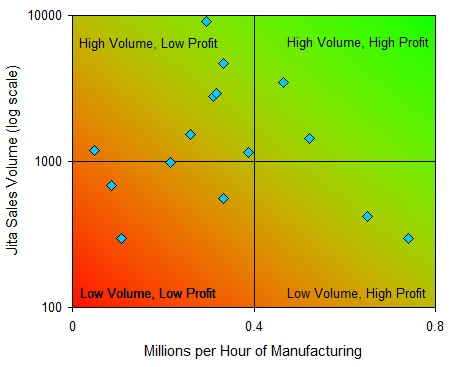
So I played about with my spreadsheet a bit and came out with this:
To explain as simply as possible:
  • The Y axis (side) is just the daily sales volume in Jita. (I changed it into a logarithmic scale only because it's easier to view the output). Further up the graph = higher number of units sold per day.
  • The X axis (bottom) is the millions of isk per hour profit I make. This is calculated by dividing the profit of the item by the time it takes to build. Further to the right = more profitable.
  • Each little blue diamond is one item I can make. They are not labelled here because I'm not giving away all my secrets! The point of this post is to show you how to build useful tools, not give out freebie advice.
So in the end we have 4 quadrants, high volume/high profit quadrant (top right) containing the best items to make.

The most profitable items don't sell many units per day, so I've got a bit of an overstock of them that will probably take me a while to shift. They end up in the bottom right quadrant - low volume but high profit. I do want to keep manufacturing them, but if I devoted all my slots to that I'd make more than 10 times what I could sell and end up with a lot of T2 stuff hanging around my hangar floor.

Building a spreadsheet like this is extremely helpful when deciding what to manufacture - it wasn't until building this that I can really focus my efforts. If you know how profitable your items are (and you should!) then all you need to do extra is find a source for the volumes. I used Eve Tools. It's really not hard to do.

I hope this sort of analysis helps other budding Eve entrepreneurs!

Tuesday, 1 March 2011

February in review

The wallet journal downloads seem to have gone a bit wrong (thanks CCP!), which is going to make my corporation reporting a pain. Here's a few basic things this month (it'll probably take me a while before I can do the full reporting I did previously):
  • My POS got blown up when I was away, my own fault really, I forgot to refuel. Had to relocate as there were no moons left in my old home, and also buy a new POS. Bummer.
  • Despite this I still managed to increase the corp wallet by around 200m isk.
  • Partly this was down to dumping my stockpile of PI products, bought back when they were not PI products, for a sizable profit. A one-off divestment to counter my (hopefully) one-off investment in a new POS.
  • Other than that I've been doing some PI (and blogging about that this month) and that averaged 1.6m isk per planet per day, 20% below my target although that includes a 7 day cycle.
  • Invention is working nicely with the use of base items to boost my chances. I ended up with 62% success rate (112 successes out of 181 attempts to be exact).
  • And of course I've also been selling T2 as well, which is generally up in profitability as discussed in the last post.
In summary: a lot of fiddly tasks done (anchoring a POS, much hauling, setting up planets) but things are set up well for March when I should also be able to bring more manufacturing online and work through the backlog of T2 blueprints that the use of base items in invention has allowed me to generate.

Sunday, 27 February 2011

Tech II invention profitabilty up despite technetium

Having taken a break from Eve for a while, but now back again, I thought I'd better take a look at how profitable my items are today. When I compared this to how it was 8 months ago, the results make for some quite interesting analysis. I'm going to use the example of Cap Recharger II modules, one of the most traded tech II items.

Despite technetium prices going through the roof, increasing the prices of construction components (Nanoelectrical Microprocessors and Tesseract Capacitor Units), the launch of PI increasing prices of Superconductors, and the mineral basket increasing, overall costs have gone up by only 3.7%. There has been a huge decline in the costs of datacores and this has almost entirely offset the increases of all the other materials required. Note: I have included everything except taxes (constant) and the cost of lab jobs ("zero" for me since I use a corp POS but then of course I have fuel bills to pay, not included here, and they have increased drastically).

Not only have costs gone up, but so has the price of the finished product as well. Right now Cap Recharger II's are at a high price, which may not last, but here's the breakdown of the costs versus the sales price anyway:
Up to 62% profit, very nice indeed. The sale price has increased at about 8 times the rate of the price of the cost of materials.

Prices have been quite turbulent over the last 6 months though, as shown on the graph below (thanks to Eve-Tools for the data). Even at the low of 450,000 isk per module, there's still 33% profit margins to be made.
Unfortunately I can't find a good reason for the changes in price. The price decline in November followed a spike in volumes (number of units traded), but otherwise price seems only weakly related to volume.

Regardless, I'm happy. Although I've just analysed Cap Recharger II's here, this seems to be a general trend with the tech II modules I produce (about a dozen different modules) - costs up by a small or moderate amount, but market prices of (most) end products up enough to compensate.

Monday, 21 February 2011

The long and the short of it

After trying longer extraction times, the average across all my planets is that 7 day extraction times produce the equivalent of 2.7 days worth of materials if I was running 24h extraction times. So just over a third the amount of materials. That puts every planet at under 1m isk per day. Across the two characters that's still be over 250m isk a month at almost zero effort.

I did that through necessity (away for a week without Eve access) but it was also a useful exercise. It's clear which planets had seemed good but in fact I was extracting from "nuggets" which have now disappeared, and which planets are genuinely good planets. Nuggets are temporary pockets of resources which don't renew but once they're extracted, they're gone. It definitely takes a few days to see what's what on planets - patience is a virtue when it comes to PI (and Eve generally, really).

There are 4 or 5 planets of my 12 that I'm going to change based on their output so far. That means losing out on having my own supply on a couple of POS fuels, but that's business - my aim to to maximize revenues, not look after my own supply. It's not like I'm in a wormhole - my POS is in high sec where there's no risk attached to hauling POS fuels, and no shortage of sellers either.

Friday, 11 February 2011

PI setups

So far my PI has been largely around producing P2. Typical inital setup is:
  • 2 x ECU
  • 4 x Basic Industry Processor
  • 2x Advanced Industry Processor
  • 1 x Launchpad
Everything gets routed to/from the launchpad. There's a screenshot below.
The eagle-eyed amongst you will notce there are actually 5 basic processors there. This planet is producing a bit more material than the 4 basic processors would consume, but not a lot more. So my optimised setup is to swap the 5th processor between the two P1 products each day. Note that I don't need to rebuild it, only change the schematic, which is free to do. At some point I will have to build another advanced processor to use up those extra P1, or ship them to another planet to have the P2 manufactured there.

My "best" planet actually has 6 basic and 3 advanced processors, but for most of my planets it's 4 and 2.

I'm also trying out a bit of P1 but that's a pain because of the hauling required. It seems to need emptied every day and a half. Setup is below:
You can see there is only 1 ECU. The 8 basic processors keep pace almost exactly with the 10 extractor heads. Not quite sure how best to optimise this. I have tried adding an extra ECU but then I can only fit on a couple of heads and no processors to actually convert the extra material to P1.

More to come as I optimise the planets more!